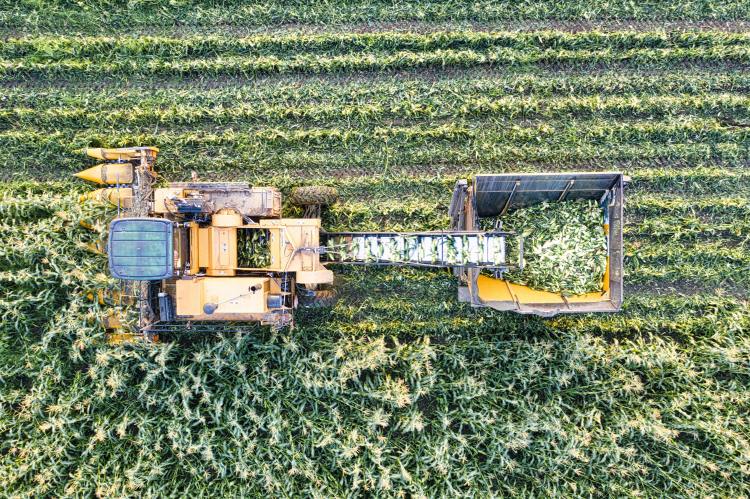
Preparing Ohio for the post-peak corn world (AKA the Corpocalypse!).
- A Plan for Ohio Agriculture After Ethanol
- 1. Diversifying Ohio Agriculture
- 2. Transitioning Land to New Productive Uses
- 3. Reforestation, Rewilding, and Conservation
Corn has become a dominant crop in agriculture. One of the largest drivers of corn production has been government subsidy, government mandate, and market drive toward ethanol production as a supplementary alternative fuel source. Corn was grown on over 90 million acres of farmland in the US in 2024 and nearly a third of corn production, around five billion bushels, is used in ethanol production for use as an additive in gasoline.
At the same time, electric vehicles, which use no gasoline, are quickly growing in market share. Over one in five new cars sold in 2024 globally were electric, with nearly 50% of new cars being electric in China and 92% in Norway. Electric will continue to increase in market share. On a day sooner than expected, the internal combustion engine may be no more. At which point, ethanol fuel production would likely cease.
Ohio has 13.5 million acres of land under farm operation, 3.4 million of which is planted corn. Ohio is the seventh largest producer of fuel ethanol in the United States. This represents billions of dollars of direct and indirect economic activity. Ohio’s corn yield per acre is much lower than other states in the corn belt such as Nebraska, Iowa, Illinois, and Indiana. Considering that roughly 30 million acres of corn production goes to ethanol and that Ohio’s 13.5 million acres of total farmland are on average less productive than farmland in other states, the ramifications for an end to ethanol fuel production would be beyond the 1.5 million acres of ethanol corn production in Ohio or the 3.4 million total acres of corn production. A majority of Ohio farmland could see rapidly declining cost effectiveness if 30 million acres of higher yielding farmland are in need of new markets. In the most drastic circumstances, depending on larger national and global agriculture trends, much of Ohio farmland could drop out of production entirely.
While the speed of the energy transition cannot be entirely predicted, in this instance, the end result is as predictable as it is inevitable. Electric vehicles will replace the internal combustion engine, gasoline will see a significant decline in consumption, and ethanol production will become an obsolete industry. The repercussions will be immense. There is, however, time to prepare.
A Plan for Ohio Agriculture After Ethanol
My plan rests on three main approaches:
- Agricultural Diversification – Supporting research, innovation, and markets for alternative crops
- Alternative Land Use – Transitioning farmland to energy production, housing, industry, and infrastructure
- Reforestation and Rewilding – Converting marginal farmland into productive forests and natural areas
1. Diversifying Ohio Agriculture
Agriculture has moved toward extreme monoculture, not just very few main crops but very few varieties of those crops. That system delivered efficiency, financialized markets, and global scale. But the future is in variety, specialization, and decommodification.
Take the Ohio Pawpaw. A tremendous fruit, some would say the best fruit. But it has no market! No national or global supply chains to support its development and distribution. This is a solvable problem. It needs new techniques, specialized technology, and to solve a coordination problem, but it’s doable. The world is going to learn to love the pawpaw. That’s one example among thousands of potential foods we just haven’t cared to cultivate.
These changes aren’t big government interventions, they’re certainly less invasive than our current system that allows government subsidy to decide crops and leave lands vacant. These are primarily aimed at lowering costs by innovation and opening new markets, providing new opportunity and frontiers for growth.
Investing in Research and Innovation
Ohio is home to world-class universities and agricultural research institutions. We will leverage that strength to:
- Invest in research on alternative crops suited to Ohio’s soils and climate
- Identify crops for a changing environment
- Develop open-source GMOs to break ag monopolies and bring this technology
- Invest in research and development of agricultural technologies
- Precision agriculture
- Automation and robotics
- Processing machinery for new crops
- Preservation of new crops for global markets
Education, Markets, and New Demand
We will also support:
- Educational programs to help farmers grow, process, and market new crops
- Support for local and regional supply chains, storage, and processing infrastructure
- Market development to expand what people eat and what Ohio grows
Decommodification
Decommodification is the future in agriculture and in everything else. Declining costs of information processing and collection (let’s not forget the Internet of Things) will enable incredibly fine-grained knowledge to be readily available.
Right now to easily serve globalized markets, we grow everything to be as the same as possible. There’s no consideration of high quality or variety, there’s no incentive for it. But with AI and other technologies, it will actually be possible to assess different crops, different individual fruits and vegetables, for whatever specific characteristic a consumer is looking for, and provide it to them at increasingly reasonable costs.
In terms of food, this will probably start first for higher calibre restaurants aiming for very precise tastes, but will spread from there.
These changes will ultimately allow Ohio farmers to be profitable, Ohio to become much more of an agricultural export powerhouse, and give Ohioans access to high quality, healthy, fresh food.
2. Transitioning Land to New Productive Uses
Not all farmland will remain in agriculture. Some of it can and should be transitioned to other productive uses that serve Ohio’s economy and population. This part of our strategy focuses on indirect regulatory support and targeted investment to facilitate land transitions toward energy, housing, industry, and infrastructure.
Clean Energy Production
Ohio has tremendous potential for renewable energy generation, particularly solar and wind power. Former agricultural land is ideal for these installations. We will:
- Streamline permitting processes for renewable energy projects
- Guarantee swift grid connections to make Ohio attractive for energy investment
- Support agrivoltaics combining solar panels with continued agricultural use underneath
- With grid connections
- Education
- Research
This will create jobs, generate tax revenue, provide farmers with lease income, and build the clean, cheap, abundant energy Ohio needs to power our 21st-century economy and lower costs for Ohioans.
Housing, Industry, and Infrastructure
Ohio’s smaller cities have room to grow, often surrounded by farmland (and yet often not integrating economically). Investing in Ohio’s small and medium sized rustbelt cities is a top priority through this campaign. We expect these investments to attract people and businesses eager to take advantage of an opportunity for excellent, low-cost places to live and work and grow. Some former farmland near these communities will naturally transition to development.
Large infrastructure projects: expanded rail networks, high-speed rail corridors, and modern transportation systems, will require land between cities. These investments will boost economic development and network growth while providing landowners fair compensation and reducing excess market capacity for farmers who would otherwise lose value.
By revitalizing smaller cities and connecting them more effectively, we create demand for land while strengthening Ohio’s economic geography.
These aren’t handouts, these are wise investments with positive externalities for a changing agricultural landscape.
3. Reforestation, Rewilding, and Conservation
The first two approaches rely primarily on investment, education, and regulatory reform that is largely hands-off market forming. The third involves direct state intervention at times but for the benefit of all Ohioans.
Ohio was once covered in magnificent forests. Some would say the best forests. We talk about preserving the rainforests but we used to have tremendous forests right here and we cut them down. The world has changed and we can have those forests again.
Forestry and Rewilding as Economic Opportunity
Forests are not dead land, they’re economically productive in ways that are often underappreciated.
- Timber production generates long-term revenue (supported further by expansion of multi-story wood buildings)
- Non-timber forest products: mushrooms, wild fruits, nuts, medicinal plants; create niche markets
- Ecotourism: hunting, camping, hiking, horseback riding, off-road trails, cabins
We will provide technical assistance and education on forest management, showing landowners how to profit from forestry. For many, this can be done without any state financial intervention at all. Much of southeast Ohio already is developing this thriving ecotourism industry and it can only grow.
Carbon Capture and Global Markets
Rewilding and reforestation also creates opportunities for carbon capture. Which some may have noticed, has a rapidly growing market. We’re not suggesting Ohio go so far as to develop its own carbon credit system. Instead, we will support efforts for Ohio property owners to tap these national and global markets.
- Measure and verify carbon sequestration
- Access domestic and global carbon credit markets
- Monetize conservation without navigating complex markets alone
A $500 Million Farmland Transition Fund
Beginning in 2030, Ohio will capitalize a $500 million fund to purchase farmland directly at fair market value, prioritizing the least productive land. This is our big state intervention. We are looking to acquire quite a bit of land as its value collapses. This will be an asset the state retains for future uses.
This serves multiple goals at once:
- Provides a fair exit for struggling farmers
- Prevents a hard crash in land values
- Gradually reduces excess agricultural land supply
- Keeps the private land market functioning for remaining farmers
The land acquired will go toward rewilding and reforestation (unless otherwise used for infrastructure projects). Reforestation has tremendous benefits:
- Combat climate change
- Improve air quality and public health – pollution kills and worsens living while causing crime, look it up! This will lower the cost of healthcare.
- Stabilize local and regional climates – warmer winters, cooler summers, look it up!
- Restore ecosystems and wildlife
- Expand tourism and outdoor recreation economies – improving the economy and the physical and mental health of Ohioans.
Be prepared for the cornpocalypse.
 Tim Grady For Ohio